Contents
- 1 EPS Higher Pension: 99% Applications Cleared by EPFO – Full Story & Guide
- 1.1 The Big “Good News”: Files Are Finally Moving
- 1.2 The “Bad News”: Minimum Pension Stuck at Rs 1,000
- 1.3 Flashback: Why Did This “Higher Pension” Hungama Start?
- 1.4 The Calculation: How Much Money Will You Actually Get?
- 1.5 The Price You Have to Pay (The Catch)
- 1.6 Why Did Some Applications Get Rejected?
- 1.7 Is It Worth Taking the Higher Pension?
- 1.8 What Should You Do Now?
- 1.9 Financial Planning Beyond Government Schemes
- 1.10 Conclusion
- 1.11 Frequently Asked Questions
EPS Higher Pension: 99% Applications Cleared by EPFO – Full Story & Guide
If you are a salaried employee in India, the words “EPS Higher Pension” have probably been buzzing in your ears for the last two years. It has been the hottest topic in every office canteen, every family WhatsApp group, and every bank queue. We all have that one uncle or colleague who keeps asking, “Arre, what happened to my higher pension application? Is the government actually going to give money or is it just talk?” Well, finally, we have a solid answer. And for once, it is actually some good news mixed with a little reality check.
According to the latest statement given in the Parliament, the Employees’ Provident Fund Organisation (EPFO) has cleared nearly 99 percent of the applications for the higher pension. Yes, 99 percent! This is a huge relief. After months of website crashes, confusing forms, and endless waiting, the files are finally moving. But, wait. Before you start celebrating and planning a world tour, there is also some serious news about the minimum pension of Rs 1,000 that might disappoint many people. Today, we are going to sit down and talk about this entire situation in simple, easy English. We will look at what the government said, how to check your status, and if this scheme is actually good for you or not.
The Big “Good News”: Files Are Finally Moving
Let us start with the positive part. For a long time, people were very frustrated. You submitted your “Joint Option Form” online, and then… silence. The status just showed “Pending” for months. It felt like typical sarkari work, right? But recently, Minister of State for Labour & Employment, Shobha Karandlaje, stood up in the Lok Sabha and gave some actual numbers.
She told the Parliament that out of the 17.49 lakh applications received from employees, almost all have been processed. The EPFO staff has worked hard to clear the backlog. To be exact, they have issued “Demand Letters” to over 4.27 lakh people. Now, what is a Demand Letter? Think of it like a bill. The EPFO is saying, “Okay sir/madam, we accept your request for a higher pension. But first, you have to return the extra money that went into your PF account with interest. Once you pay this, we will start your higher monthly pension.”
The best part is that for retired people, the money has actually started flowing. About 1.24 lakh pensioners have already received their revised Pension Payment Orders (PPOs). A PPO is that magic document number that ensures your monthly credit. Seeing these numbers, we can finally say that the scheme is not a fake promise. It is real, and it is happening.
The “Bad News”: Minimum Pension Stuck at Rs 1,000
Now, let us talk about the other side of the coin. While the higher pension is great for people with big salaries, what about the common worker? There are lakhs of pensioners in India who get a tiny pension of just Rs 1,000 or Rs 1,500 per month. Can anyone survive on Rs 1,000 in 2025? It is impossible. You cannot even buy milk and bread for a month with that amount.
For many years, pensioner unions have been fighting. They have been protesting and demanding that the minimum pension should be increased to Rs 7,500 per month. They also want Dearness Allowance (DA) like government employees get, so the pension increases when inflation goes up. But the government has said a clear “No” in the Parliament.
The Minister explained that the Pension Fund is already running in a “deficit.” In simple language, this means the fund is losing money. The amount of money collected from employees is less than the amount needed to pay pensions. The government is already giving money from its own pocket (budgetary support) just to keep the pension at Rs 1,000. Increasing it to Rs 7,500 is just not possible right now because the government does not have that kind of extra cash for this scheme. So, if you were hoping for a hike in the minimum pension, that door is closed for now.
Flashback: Why Did This “Higher Pension” Hungama Start?
To understand why everyone is running after this scheme, we need to go back in time a little bit. It is like a movie flashback.
When the EPS scheme started in 1995, the rule was that your pension would be calculated on a small salary limit. First, it was Rs 5,000, then Rs 6,500, and finally Rs 15,000. It did not matter if your actual salary was Rs 1 Lakh or Rs 2 Lakhs. The government only looked at Rs 15,000 to calculate your pension. Because of this cap, people were retiring with peanuts—pensions of Rs 2,000 or Rs 3,000.
But in November 2022, the Supreme Court of India gave a historic judgment. The judges said this was unfair. They said if an employee is willing to contribute to the pension fund on their “Actual Salary” (full salary), the government cannot stop them. This verdict changed everything. Suddenly, people realized their pension could jump from Rs 3,000 to maybe Rs 25,000 or Rs 30,000! That is why 17 lakh people rushed to apply online.
The Calculation: How Much Money Will You Actually Get?
This is the part that confuses everyone. People ask, “How much will I get?” Let us do some simple math. Do not worry, no complicated formulas here.
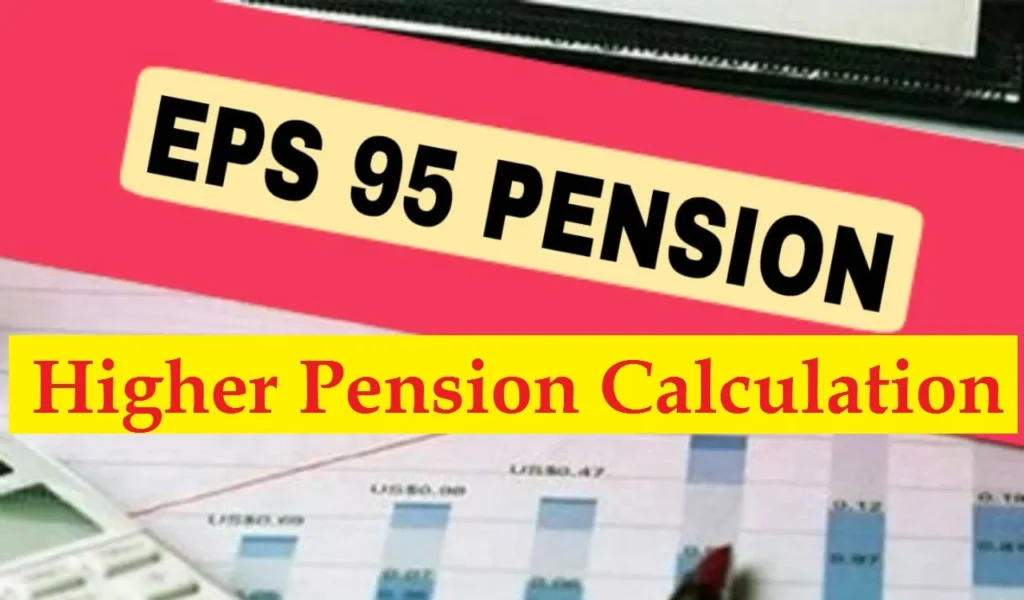
The standard formula for pension is:
(Pensionable Salary multiplied by Years of Service) divided by 70.
Old Scenario (Capped):
Imagine you worked for 30 years. Even if your salary was high, the government capped it at Rs 15,000.
So, pension = (15,000 x 30) / 70 = Rs 6,428 per month.
That is the max you could get.
New Scenario (Higher Pension):
Now, the cap is removed. Let us say your average salary for the last 5 years was actually Rs 80,000.
So, pension = (80,000 x 30) / 70 = Rs 34,285 per month.
See the difference? From Rs 6,000 to Rs 34,000! That is a life-changing amount for a retired person.
The Price You Have to Pay (The Catch)
Now, you might think, “Wow, this is free money!” No, nothing is free in this world. To get this higher monthly amount, you have to pay a heavy price today.
In the past, a large part of your PF contribution went into your EPF account, which earned interest and became a big lump sum amount. Only a tiny part went to the Pension fund. Now, if you want higher pension, you are telling the EPFO to shift all that money from your EPF to the Pension fund retrospectively (from the past dates). This amount can be very big—sometimes Rs 15 Lakhs or Rs 20 Lakhs.
When you get the “Demand Letter,” it will say something like: “Please pay Rs 18 Lakhs from your PF balance to the Pension fund.” If your PF balance has that much money, they will cut it. If your balance is low (maybe because you withdrew money for a house or marriage), you will have to pay the difference from your bank account. This is the hardest decision. Do you give up your hard-earned Rs 20 Lakhs lump sum today to get a monthly pension later? It is a tough choice.
Why Did Some Applications Get Rejected?
Even though 99 percent of applications were cleared, about 34,000 people got a rejection letter. It is heartbreaking to wait for two years and then get a “No.” Why did this happen?
The main reason was money. When EPFO sent the Demand Letter asking for the transfer of funds, many people did not pay. Maybe they did not have the money, or they changed their mind. If the money does not go into the pension pot, the pension cannot be paid. Simple logic.
Another reason was spelling mistakes and data mismatch. In India, our names are written differently in different documents. “Ramesh Kumar Sharma” in Aadhaar might be “Ramesh K Sharma” in the PF office. These small computer errors caused rejections. Also, some people who retired long before 2014 and were not eligible still applied in hope. Their forms were naturally rejected by the system.
Is It Worth Taking the Higher Pension?
This is the million-dollar question. Should you go for it? Let us look at the pros and cons simply.
Why it is Good:
It gives you “Social Security.” You know that no matter what happens to the stock market, you will get Rs 30,000 every month until you die. It gives you peace of mind. Also, if you die, your spouse gets 50 percent of that amount for life. It is very safe.
Why it might be Bad:
You lose your capital. If you keep the Rs 20 Lakhs in your PF, you can withdraw it and buy a house, or keep it in a Fixed Deposit. If you die, your children get the full Rs 20 Lakhs. But in the pension scheme, if you and your spouse die, the money is gone. The government keeps it. Your children get nothing. So, if you want to leave an inheritance (jaydad) for your kids, this scheme is bad. If you want a tension-free monthly income for yourself, this scheme is good.
What Should You Do Now?
If you have already applied and are waiting, check the EPFO portal. If you see a “Demand Letter,” read it carefully. Check the calculation. If the amount they are asking for is correct, give your consent immediately. Do not delay, because there is usually a deadline.
If you are a retired person and you have already received the PPO, congratulations! Make sure to submit your “Life Certificate” (Jeevan Pramaan) every year in November. If you forget this, your pension will stop. You can do this easily at any bank or using the FaceRD app on your mobile.
Financial Planning Beyond Government Schemes
One big lesson from this whole episode is that we cannot depend only on the government. The government has clearly said they have a fund deficit. They cannot increase the minimum pension. Who knows what the rules will be 20 years from now?
So, if you are still young and working, do not just look at EPF. Start investing in other things. Look at the National Pension System (NPS), start a small SIP in mutual funds, or buy a PPF. You need to have your own backup plan. Do not leave your old age in the hands of “sarkari” rules.
Conclusion
The news that 99 percent of EPS higher pension files are cleared is a big win for the common man. It shows that the system, although slow, eventually works. It is a relief for lakhs of families who were waiting for this extra income. While the minimum pension of Rs 1,000 remains a pain point, the progress on the higher pension front is definitely a step in the right direction. So, if you are one of the lucky ones who got the PPO, enjoy your retirement. You earned it.
For more official details, you can always visit the EPFO Member Portal.
Frequently Asked Questions
1. I missed the deadline. Can I apply for higher pension now?
No, the deadline is over. You cannot apply now unless the court opens the window again.
2. My status shows “Process Initiated.” What does it mean?
It means your application is valid and the officer is calculating your amount. You will get a letter soon.
3. Will my wife get the higher pension if I die?
Yes, the spouse gets 50 percent of the member’s pension for their entire life.
4. Is the higher pension taxable?
Yes, the monthly pension you receive is fully taxable as salary income.
5. Why is the government not increasing the Rs 1000 pension?
The government says the fund does not have enough money and is running in a loss.
6. Can I calculate my pension on my own?
Yes, there are Excel calculators available, but the final amount will be decided by the EPFO officer only.